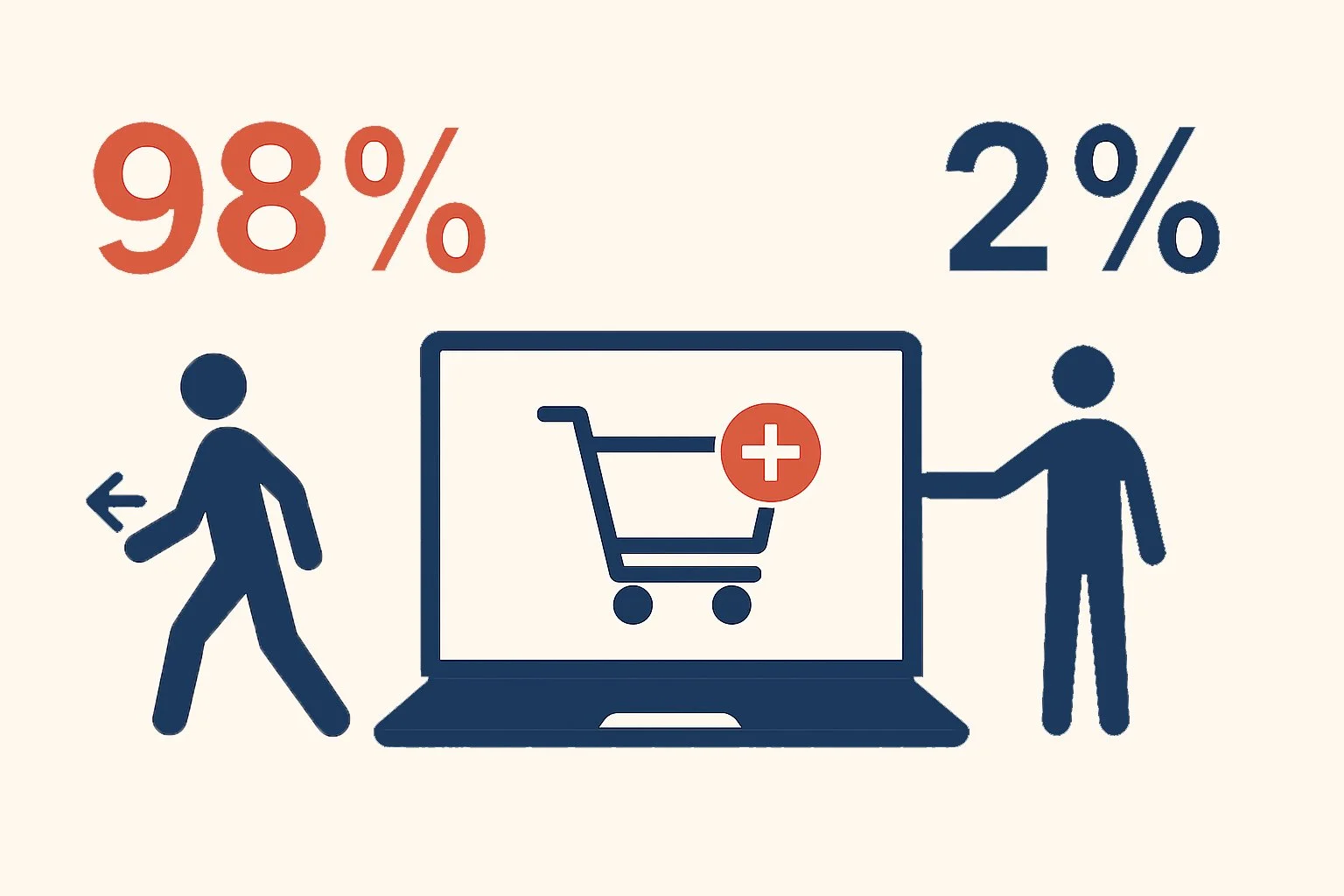
On a typical ecommerce website or landing page, 98% of website visitors leave without buying anything or submitting any contact information. They browse your products, maybe add something to their cart, then disappear into the digital ether. They don’t give their email in an opt-in, no forms submitted and certainly no phone number for text marketing.
For most ecommerce store owners, this feels like watching potential customers walk through your front door, look around, and leave without saying a word. The impact of this can be highly financially and mentally draining to ecommerce operators.
But what if I told you there's technology that can identify many of these anonymous visitors and bring them into your CRM, even obtain their email address (or more)? Welcome to the world of identity resolution – a game-changing approach that's helping Shopify stores and ecommerce businesses dramatically increase their email lists and revenue. Even better, very few eCommerce operators know about or are effectively using such technology.
What Exactly is Identity Resolution?
Identity resolution sounds complicated, but the concept is straightforward. Identity resolution tools use various data points and algorithms to identify website visitors who haven't filled out any forms or provided their contact information. Identity resolution services and data brokers piece together clues about who someone is based on their browsing behavior, device information, and other available data signals. Also sometimes referred to as ‘fingerprinting’, complex user data is combined into graphs and arrays that use statistical plausibility to discern user devices and owners, even if they’re using VPNs, proxies or an array of unknown devices.
The result? You can potentially identify 15-90% more of your anonymous traffic and add them to your email marketing campaigns. For a store getting 10,000 monthly visitors, that could mean 1,500-3,000 new email addresses without changing anything about your website or customer experience. Such a high percentage of data capture can help improve top of the funnel marketing efforts and reduce ‘slippage’ typically seen in eCommerce marketing campaigns. The revenue change because of this software can be potentially enormous.
GetEmails and Customers.AI
GetEmails (now known as Retention) has built a reputation for being one of the more accessible identity resolution tools for smaller ecommerce businesses especially for Shopify stores. Their platform focuses specifically on email identification, making it perfect for store owners who want to dive into this technology without getting overwhelmed by complex features. GetEmails claims at least 70% of US-based traffic can be identified using its proprietary algorithms.
What makes GetEmails particularly appealing is their integration with Shopify. You can literally install their app and start identifying visitors within hours. The tool works by matching visitor behavior patterns with their database of email addresses, then gradually building your list with qualified leads who've already shown interest in your products.
The pricing structure is typically based on the number of identified emails, which means you only pay for results. For a small to medium Shopify store, this can translate to hundreds of new email subscribers monthly at a fraction of the cost of paid advertising.
Customers.AI: The Comprehensive Solution
Customers.AI was founded by Larry Kim, a former Google engineer who has been critical of the identity resolution industry and believed he could offer a much more powerful and accurate ‘matching’ system. Larry believes his approach could see 65-85% data accuracy rate in a third-party blind test compared to a competitor's 22%. They also claim a 65% open rate and a 25% click rate for first time email sign-ups.
Customers.AI takes a slightly different approach to identity resolution. While email identification is a core feature, they've built their platform around creating complete customer profiles. This means you're not just getting email addresses – you're getting insights into customer behavior, purchase intent, and engagement patterns.
Their machine learning algorithms are particularly sophisticated when it comes to predicting purchase likelihood. This allows you to segment your newly identified subscribers immediately, sending different email campaigns to high-intent visitors versus casual browsers. Furthermore, data can be turned into lists for use on digital marketing sites for RETARGETING purposes. Customers.AI also utilizes cross-device tracking which allows for tracking of user behavior across a user’s devices and create a singular customer profile that can be used for careful segmentation, targeting and outreach.
Revenue & Profit
Based on case studies and user reports, stores implementing identity resolution typically see some impressive results.
A mid-size fashion retailer using identity resolution tools reported identifying about 20% of their anonymous traffic, which translated to roughly 2,400 new email subscribers monthly. With an average email marketing ROI of $42 for every dollar spent, and these new subscribers converting at about 60% the rate of opt-in subscribers, they calculated an additional $15,000 in monthly revenue directly attributable to identity resolution. Other case studies have even shown a 90% drop in CAC due to the ability to identify, segment and reach out to customers.
One aspect that isn’t easily quantifiable is the long-term benefit in list growth. These aren't just one-time sales – you're building your email list with people who've already demonstrated interest in your products. Over time, these subscribers become repeat customers, refer friends, and contribute to your store's long-term growth. Furthermore, by segmenting out individuals who have already interacted with your emails, you could theoretically remove them from targeted ad campaigns and focus ad frequency on fresh or top of the funnel leads while creating a separate campaign for middle of the funnel or bottom of the funnel leads.
Furthermore, reaching out to these leads with direct mail services can help reduce digital ad costs and form a direct connection to leads and customers without middlemen digital ad networks like Facebook and YouTube which are seeing general increases in ad costs.
Beyond the Big Names: Other Players Worth Considering
While GetEmails and Customers.AI often dominate the conversation, several other platforms are making waves in the identity resolution space.
Klaviyo's Identity Resolution has become increasingly sophisticated, especially for stores already using their email marketing platform. The integration is seamless, and their machine learning capabilities are constantly improving.
Yotpo offers identity resolution as part of their broader customer experience platform. If you're already using their reviews or loyalty features, their identity resolution can provide additional value without requiring another integration.
Implementation Strategy: Making It Work for Your Store
Successfully implementing identity resolution isn't just about installing a tool and waiting for magic to happen. The most successful stores approach it strategically.
Start by auditing your current email capture methods. If you're only capturing 2-3% of your visitors' email addresses through traditional opt-in forms, identity resolution can potentially triple or quadruple your list growth rate. However, if you're already capturing 8-10% through effective pop-ups and lead magnets, the incremental gain might be smaller.
Next, consider your email marketing infrastructure. There's no point in identifying thousands of new subscribers if your email marketing strategy isn't optimized to convert them. Make sure you have strong welcome sequences, product recommendation flows, and re-engagement campaigns in place.
Privacy compliance is crucial. These tools must operate within GDPR, CCPA, and other privacy regulations. Reputable platforms handle this automatically, but it's worth understanding how they ensure compliance, especially if you serve international customers.
The Email Marketing Multiplication Effect
The real power of identity resolution becomes apparent when you consider the lifetime value of an email subscriber. Industry averages suggest that email subscribers are worth $10-50 each, depending on your products and email marketing effectiveness.
But identity resolution subscribers often have higher intent than traditional opt-ins. They've spent time browsing your products, maybe even added items to their cart. This behavioral data allows for incredibly targeted email campaigns from day one.
You can create specific campaigns for people who viewed certain product categories, spent above-average time on product pages, or showed other high-intent behaviors. This level of personalization typically results in open rates 20-30% higher than standard campaigns and click-through rates that can double your usual performance.
Looking Forward: The Future of Anonymous Visitor Identification
The identity resolution space is evolving rapidly, driven by changes in privacy regulations and cookie policies. Third-party cookies are disappearing, but identity resolution companies are adapting with first-party data strategies and improved machine learning models.
The most successful ecommerce stores will be those that start building these capabilities now, before their competitors catch on. Early adopters often see the best results because they're working with less saturated audiences and can refine their approaches while the technology is still gaining mainstream adoption.
For Shopify store owners specifically, the app ecosystem is making identity resolution more accessible than ever. What once required complex technical implementations can now be set up in an afternoon.
The Bottom Line for Your Business
Identity resolution offers a new way of handling website visitors who often come through expensive digital ads. Instead of accepting that 98% of your traffic will remain anonymous and unprofitable, you can now identify and market to a significant portion of these potential customers and increase the profitability of your marketing campaigns.
The technology isn't perfect – you won't identify every visitor, and not every identified visitor will convert. But for most ecommerce stores, even modest success with identity resolution can result in substantial revenue increases. With proper planning, tracking and setup, a 90% improvement in lead generation and lowered CPA is possible.
The ecommerce landscape is increasingly competitive, and stores need every advantage they can get. Identity resolution tools offer a way to dramatically increase your email marketing reach without spending more on advertising or changing your website design.
The question isn't whether identity resolution will become standard practice for ecommerce stores. It's whether you'll implement it before or after your competitors do.